The Church
The existing buildings of Ayia Napa Monastery date from approximately 1500, during the period of Venetian control in Cyprus, and express the Venetian architectural style, but no information concerning the original establishment of the monastery is recorded.
A local village tradition relates that some years prior to the construction of the present buildings the small cave which still forms the main part of the monastery church had become a prominent place of pilgrimage for people of nearby villages, due to the remarkable discovery of an ancient icon in the cave. Since at the time the area was forested and uninhabited, it was a rich hunting ground.
According to the tradition, on one occasion a hunter and his dog were chasing a rabbit until it mysteriously disappeared from a view. The dog kept up the chase and followed the rabbit as it sought refuge in this small cave. The hunter heard his dog continuing to bark in an excited and persistent way, and as he traced the sound, he was led to discover the cave’s small opening. As he made his way inside, however, his attention was drawn not to the rabbit, but to a miraculously illuminated icon of the Ever-Virgin Mary, which soon thereafter became famous as a sacred treasure.
The people of the surrounding area named the icon “Ayia Napa,” meaning the Holy Lady of the Forest (“napa” in ancient Greek means “wooded glen”), and began to hold annual worship ceremonies in the cave to honour it. It could be presumed that the icon had been hidden in the cave for safe-keeping during the iconoclastic controversy (8th-9th c. A.D.). Τhis icon has not survived.
During the Venetian period, the icon of Saint Napa was held in special esteem as a miracle-working icon. The historian Estienne de Lusignan (1537–1590) ranked it first among the ten Greek Orthodox and Roman Catholic miraculous icons on the island at that time.
The well in the cave, yielding fresh water for many years, leads one to suppose that the natural underground room may have at some periods been a place of refuge from enemies.
Tradition has it that, as the location gained prominence as a holy shrine, it came to the attention of wealthy girl of the Venetian nobility in Famagusta, who was in despair because of the father’s refusal to give consent for her marriage to a commoner. As a result, she resolved to leave her home and retreat to the lonely refuge of Ayia Napa. As time went on –always according to oral tradition rather than evidence–, she built a church, monastic cells, a flour-mill, and an olive press, and so the monastery came into existence, and a community of nuns was assembled.
Being Venetian, the foundress of the monastery was Catholic and built a chapel for worship in her own tradition; then adjoining it, is the Orthodox cave church that for many years served the people of the surrounding area. Now under one roof the modern visitor sees the Orthodox church and the Latin chapel.
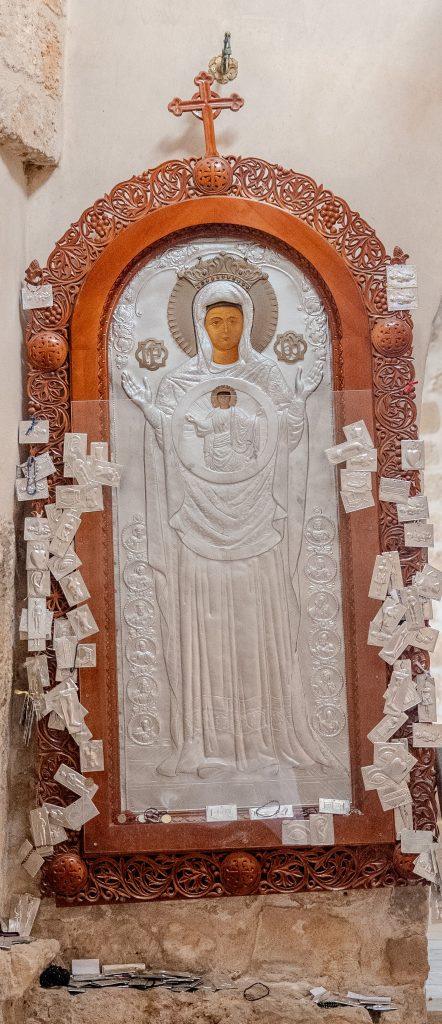
In the rear of the church’s section, carved into the rock, to the right of the iconostasis, there is now an icon of the Virgin Mary covered with a bronze casing, which replaced the lost ancient icon in the 18th century, while on the left, there is another icon (1900) of the Ever-Virgin Mary, identical to the previous one.
Today, the Orthodox church, under the Holy Metropolis of Constantia and Ammochostos, continues to be used regularly, for worship, baptisms, saints’ feast days, and the church festivals.
The Church of Ayia Napa is dedicated to the Nativity of the Theotokos and celebrates each year, on 8 September.