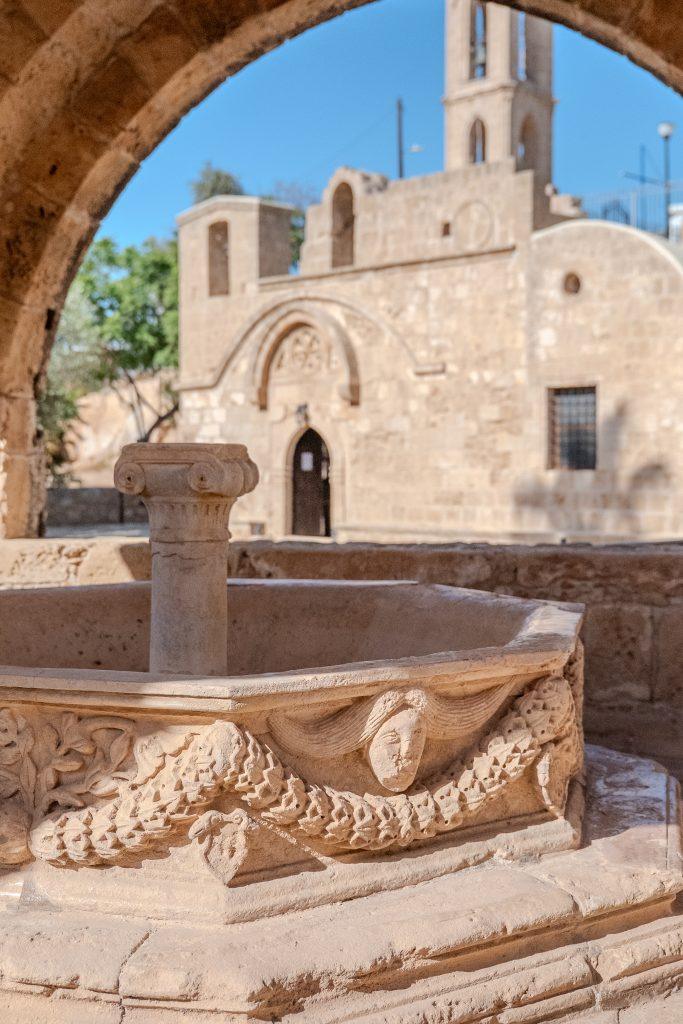
The Historic Site
At the heart of Ayia Napa Monastery lies the church, whose origins are closely bound to the sacred history of the site. Long before the construction of the present buildings around 1500, local tradition holds that the small cave forming the core of the church became a place of Christian devotion following the discovery of a revered icon of the Ever-Virgin Mary. This early spiritual significance attracted pilgrims from nearby villages and inspired the Venetian foundress to establish a monastery, building the church, monastic cells, and supporting facilities such as a flour mill and olive press.
As the monastery developed, a sophisticated water system brought water from a spring four miles away to a reservoir that irrigated fertile lands. The foundress is said to have planted sycamore-fig and mulberry trees near the reservoir; the latter supported silk production for the nuns’ garments. She also commissioned the vaulted fountain-house in the monastery courtyard, with sculpted figures including her family and symbolic imagery, and prepared her sarcophagus nearby. Another fountain in the form of a marble boar’s head may date to Roman times.
Though the present buildings date to the from approximately 1500, evidence suggests that Christian worship may have taken place here much earlier. The cave, rock cuttings, and well indicate that the site may have served as a place of refuge. Historical records confirm that the name “Ayia Napa” appeared as early as 1366, but no information survives on the existence of a monastery at that time.
The monastery flourished under Venetian rule, appearing in manuscripts and on medieval maps, and retained its position into the Ottoman period. By the mid-17th century it had transitioned from a women’s convent to a men’s monastery, owning extensive lands along the coast.
From the mid-18th century, regular monastic life declined, though the monastery retained property and influence. The surrounding village began to develop around 1790 under its protection. Restoration works were carried out in 1813, and further conservation took place during the British period (1878–1960) to preserve the historic buildings.
The 1974 Turkish invasion of the island brought a new situation to Cyprus and new challenges for Ayia Napa. Some of the refugees forced to flee from their homes in the Turkish-occupied northern Cyprus took refuge in the old buildings of the monastery for a few years.
In 1978, after extensive renovation and expansion, the Ayia Napa Conference Centre was inaugurated to serve churches of Cyprus and the Middle East. Since 2007, the monastery has belonged to the Holy Diocese of Constantia and Ammochostos.
Archaeological discoveries during restoration works in 2019 have added important new evidence to the monastery’s history and paved the way for the Ayia Napa Monastery Museum, which will be housed in the former monastic cells.